Teams often plan a move from self-managed Kafka to a managed service as if the move itself will fix the platform. Some problems do go away (broker tuning, operating-system settings, zone layout); others move with you (topic design, authentication, schemas, monitoring), and a few should be fixed before anything moves. An architecture review in InsightKafka is a way to sort them.
The environment
The fictional retailer runs two Confluent Platform 7.5 clusters on Google Cloud (orders and staging) for order management, inventory and customer analytics, with MySQL change capture and a BigQuery sink. The engagement is an architecture review with four goals: migration readiness, connector architecture, configuration for e-commerce workloads, and monitoring.
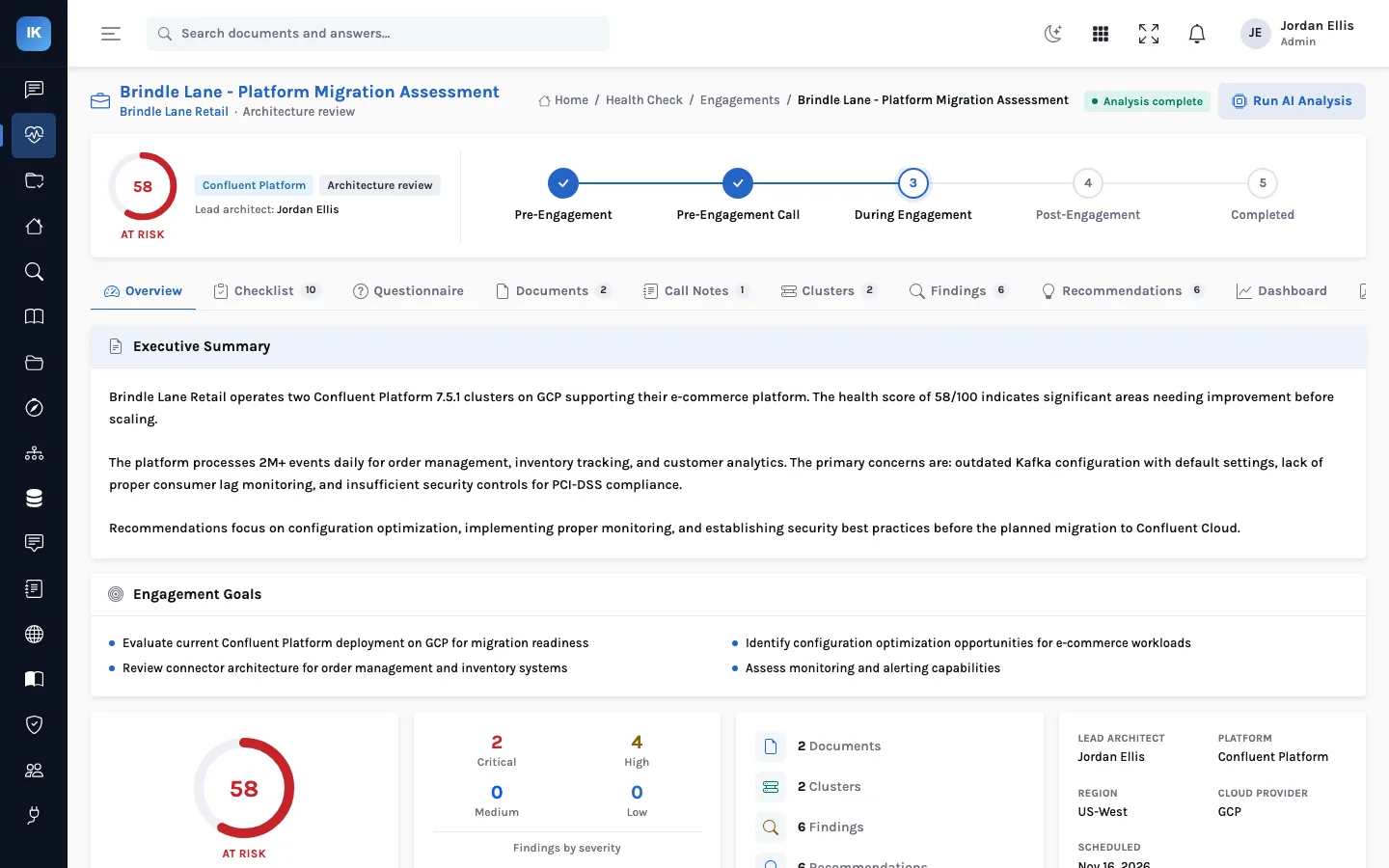
What the review found
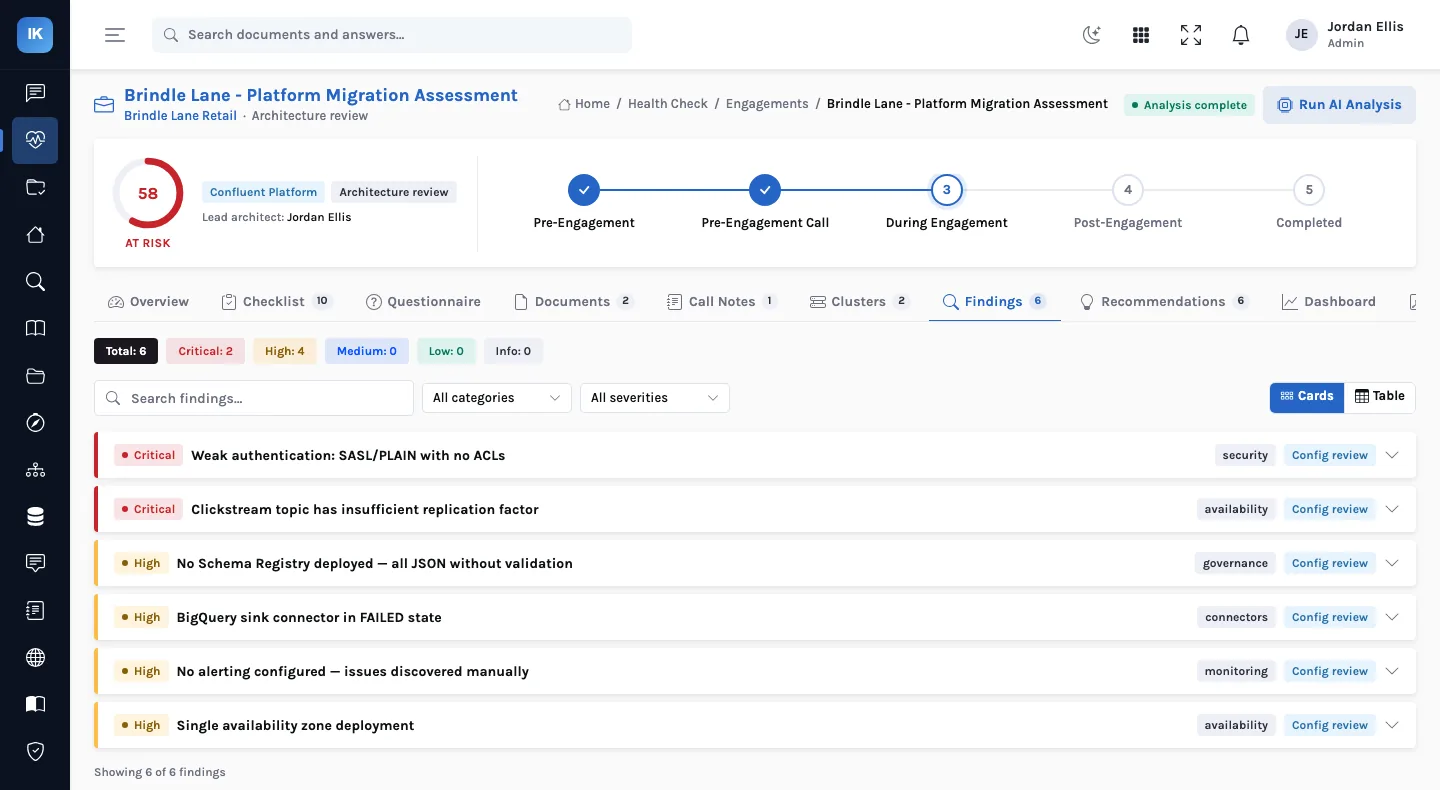
Sorting the findings for the move
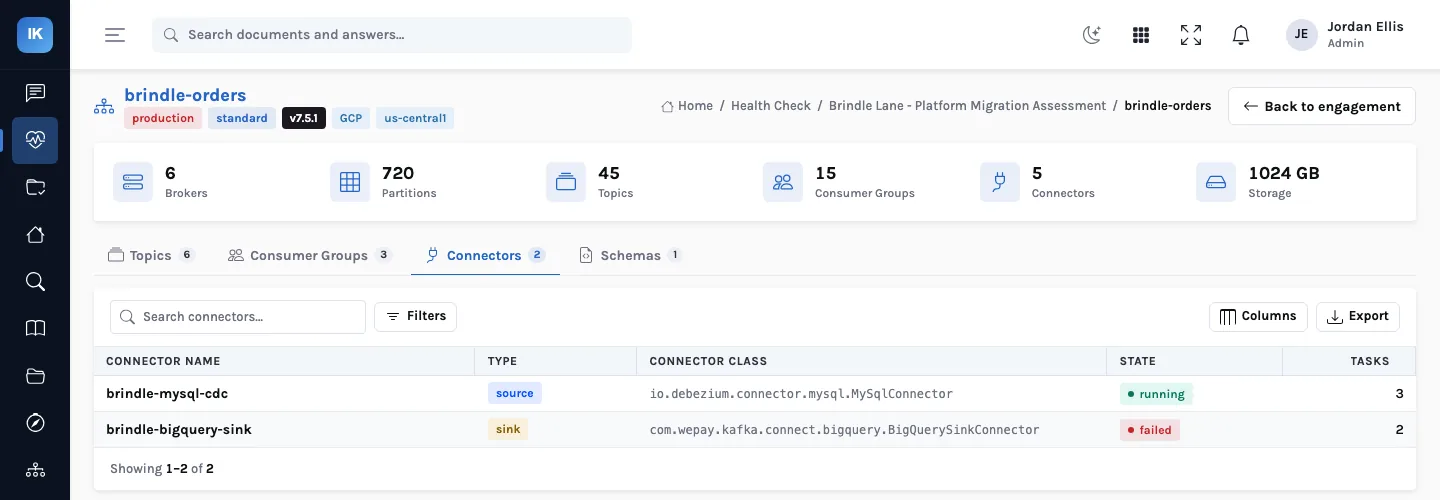
- Before the move: anything that loses data or hides problems. A clickstream topic with too few replicas can lose data today; a failed sink connector means data is already missing downstream; no alerting means the migration itself will be flown blind.
- During the move: anything the target platform does differently. Authentication and ACLs, and schema governance, are set up on the new platform anyway; design them properly there rather than patching the old one.
- With the move: anything the managed service takes over, such as zone layout and broker tuning. Check that the service tier you choose actually provides it.
Fixing the two critical findings before the move
- The under-replicated clickstream topic. Raising the replication factor of an existing topic is a partition
reassignment (in Apache Kafka,
kafka-reassign-partitionswith a plan that lists more replicas), not a configuration change. It moves data between brokers, so schedule it and throttle it. If the topic is recreated on the target platform anyway, decide whether the risk until cut-over justifies the work. - SASL/PLAIN with no ACLs. Every client can do everything today. Inventory which principals read and write which topics now, from client configuration and team knowledge; that inventory is what the target platform's access model is built from.
Questions to put to the target platform
| Area | Question | Why it matters for this retailer |
|---|---|---|
| Authentication | Which mechanisms are supported, and how are service accounts managed? | Today's SASL/PLAIN clients will all need new credentials |
| Connectors | Are the change-capture source and the BigQuery sink available as managed connectors? | Otherwise a Connect cluster still has to be run |
| Schemas | Is a schema registry included, and with which compatibility modes? | There is none today; contracts are being written from scratch |
| Replication | What replication factor and zone layout does the chosen tier enforce? | Whether the zone finding goes away with the move |
| Networking | Private connectivity from the cloud network the producers run in? | Order and inventory services must reach the new cluster |
Trade-offs in the plan
Fixing everything on the old platform first gives a clean migration but spends effort on a cluster that is being retired. Moving first and fixing after is faster but carries known data-loss risks through the cut-over. The sort above is a middle path: fix what can lose data now, design what the new platform will do differently, and verify what the managed service is supposed to take over.
Running the before-and-after comparison
- Keep the current engagement as the baseline: findings, checklist and score.
- After cut-over, start a new engagement for the same customer with the same checklist and upload the new platform's configuration and listings.
- Run the analysis and compare findings by category with the baseline.
- Explain every finding that is new, as well as every one that disappeared.
A read-out for a migration review
A migration audience wants a decision, not a gauge. A structure that works for this kind of engagement:
- The score and the two critical findings, in one slide.
- The sorted list: before, during, with the move, with an owner for each “before” item.
- The questions for the target platform, with who will get the answers.
- The date of the post-cut-over health check.
Leave the score for the end of the first slide: for a team about to migrate, the number matters less than whether the “before” list has owners and dates. Keep the six findings and their evidence as the appendix. If someone asks why an item is in “before”, the answer is on the finding.
Questions
Does InsightKafka plan the migration itself?
No. It assesses the current platform and records findings and recommendations; the sort into before, during and with the move is the architect's judgment, shown here as one way to do it.
Will the failed connector show up in the score?
If the analysis drafts a finding for it, yes: a high in connectors costs that category 15 points and the overall score 1.5. Its real weight is in the data already missing downstream, which is why it is in the “before” group regardless.
Can it assess the target platform before cut-over?
Yes, as a separate engagement, if there is a target cluster to describe. A production readiness assessment is the template designed for that point, with go/no-go criteria and readiness sections.
A migration plan with a health check at both ends
The fictional retailer's platform lead takes the three “before” items into the current quarter, writes the authentication model and schema contracts into the migration design, and books a second health check in InsightKafka for a month after cut-over, on the new platform, with the same checklist. Comparing the two engagements' findings is the evidence that the migration improved the platform rather than just moving it.