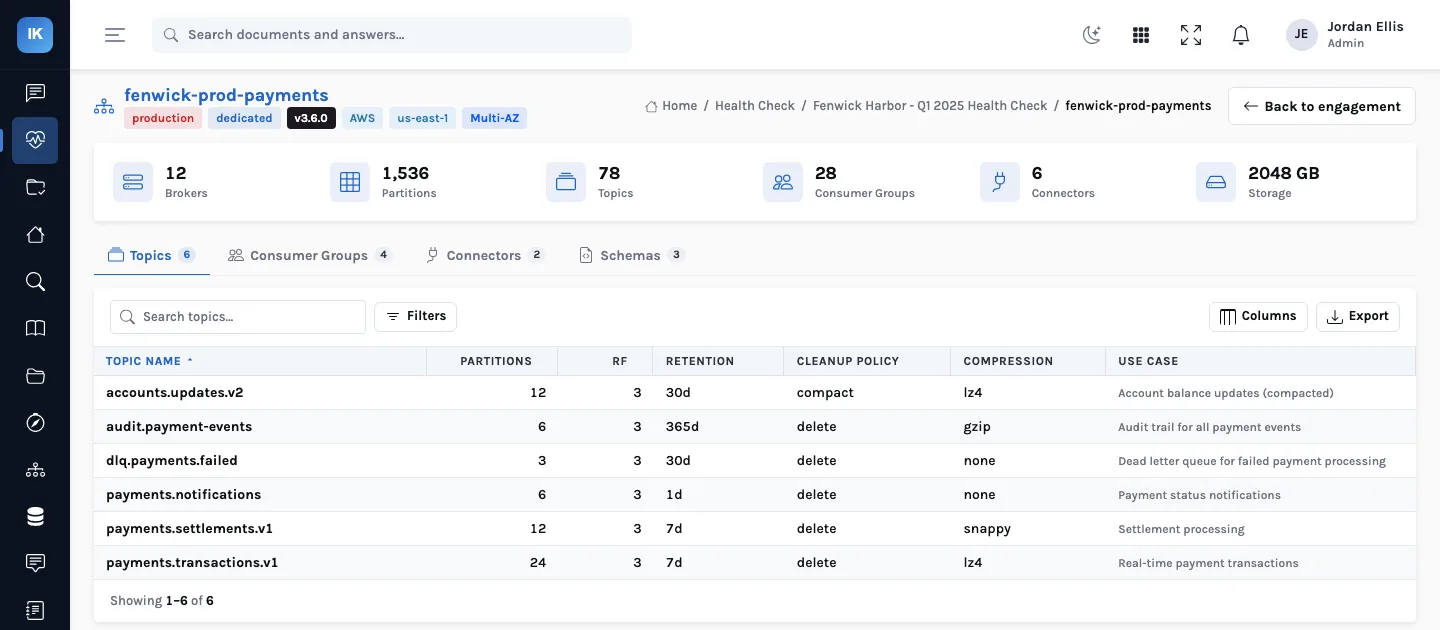
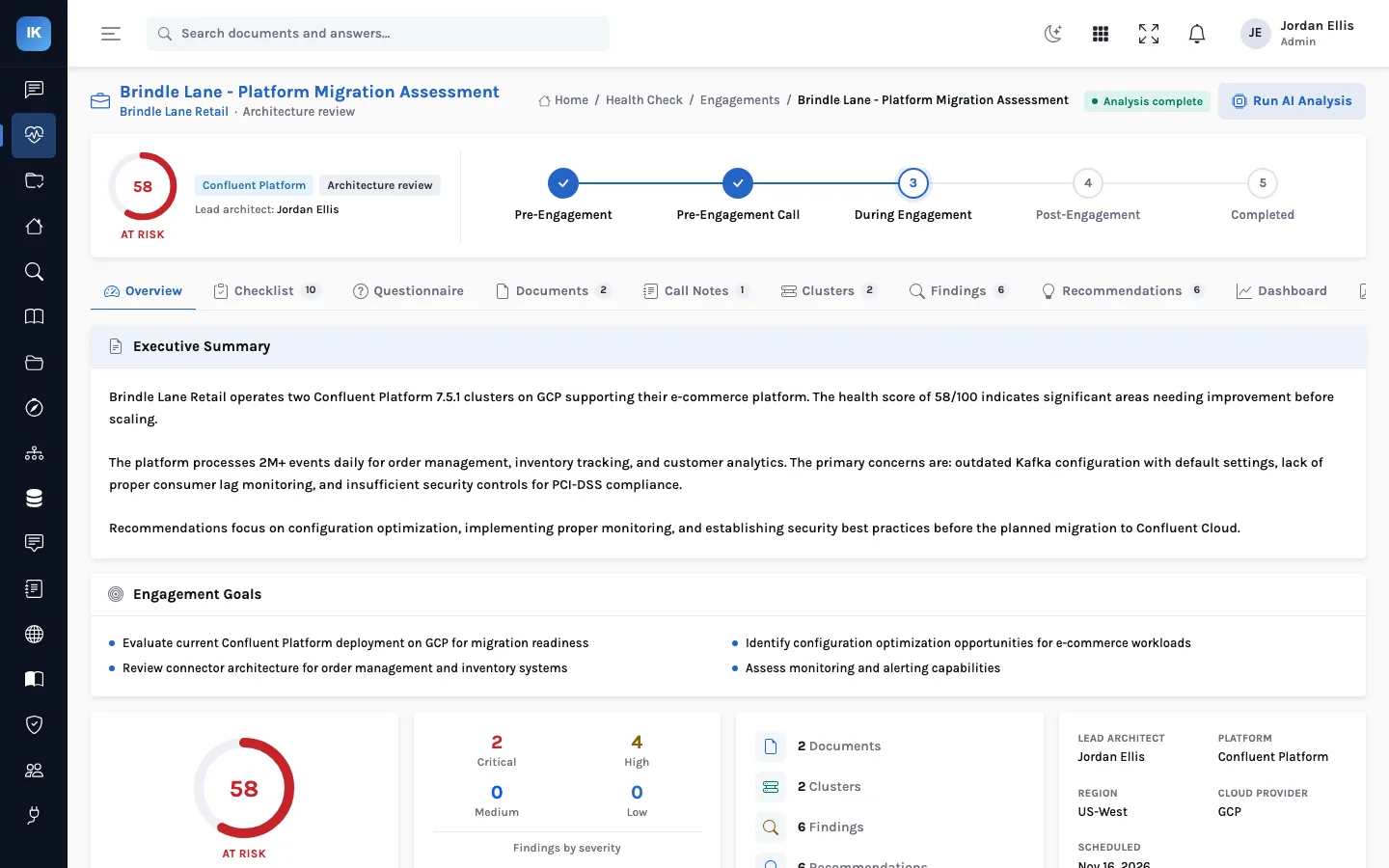
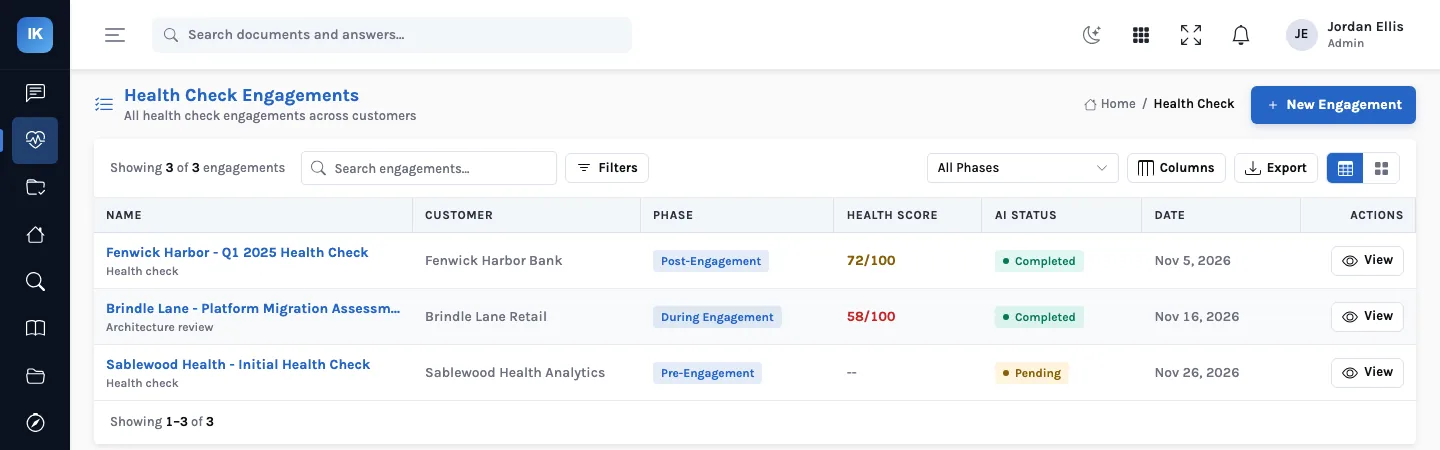
Half of what a health check learns does not come from configuration files. It comes from the intake questionnaire (how many clusters, which features, what the team worries about) and from the calls, where someone mentions that consumer lag spikes every morning. That evidence is easy to lose. InsightKafka keeps it, structures it, and makes it part of the analysis.
Documents: classified, then parsed
Every uploaded document gets a type (questionnaire, configuration file, connector configuration, topic list, consumer group list, architecture diagram, call notes, monitoring screenshot, security audit, or custom) and, with auto-parse switched on, is parsed in the background. Spreadsheets, Word and PDF documents, text, JSON, YAML, properties files and images are accepted. Each document shows its status and a one-line summary of what was found.
The questionnaire becomes data
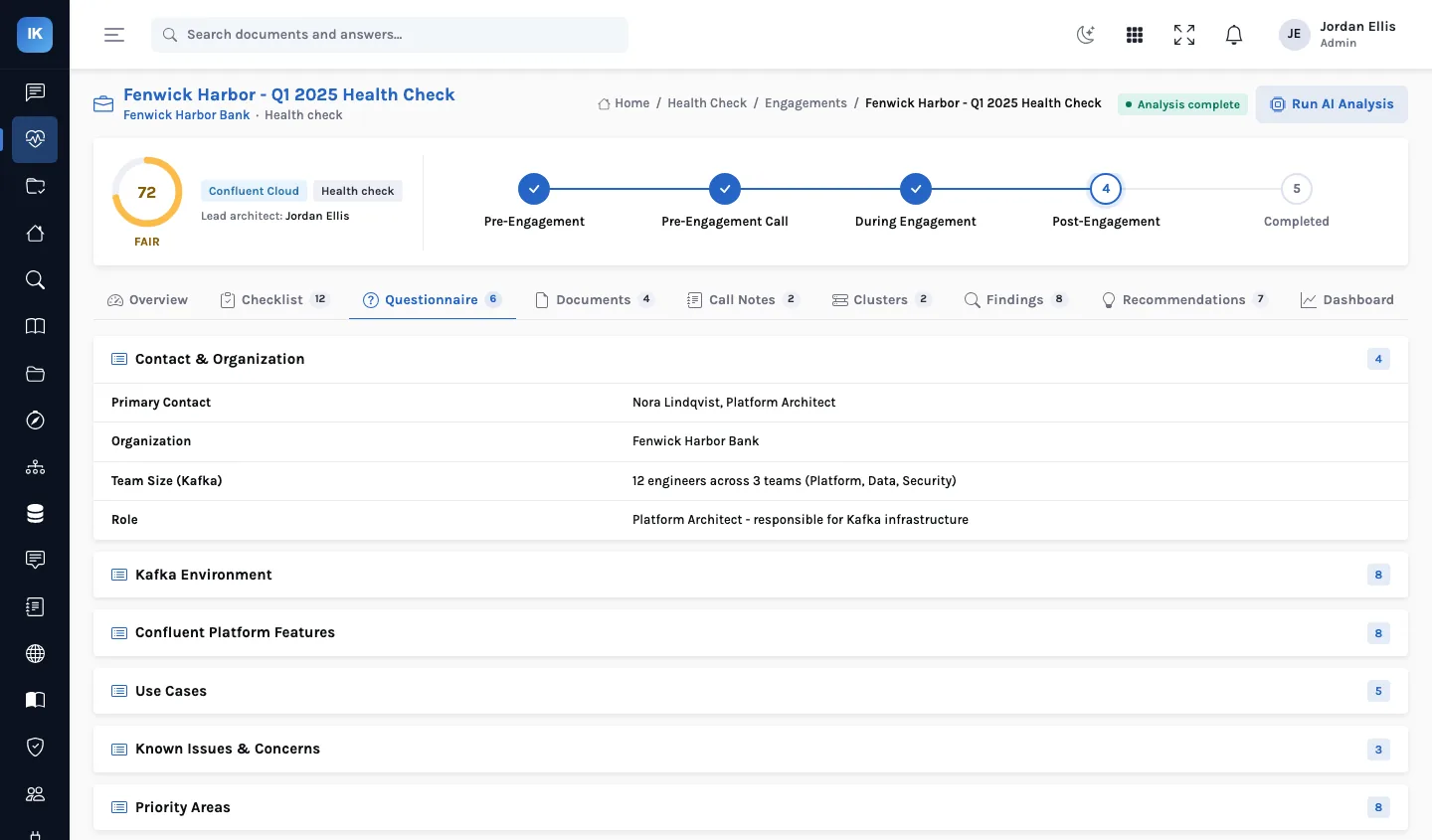
An intake questionnaire is usually a spreadsheet with dozens of questions across a few sections. Parsed, it becomes structured answers grouped by section: contact and organization, the Kafka environment, platform features in use, use cases, known issues and priority areas. When the answers describe clusters, InsightKafka creates the cluster records (and their topics, where listed) in the engagement, so the cluster view is populated before anyone has typed a broker count.
Call notes: raw and structured, side by side
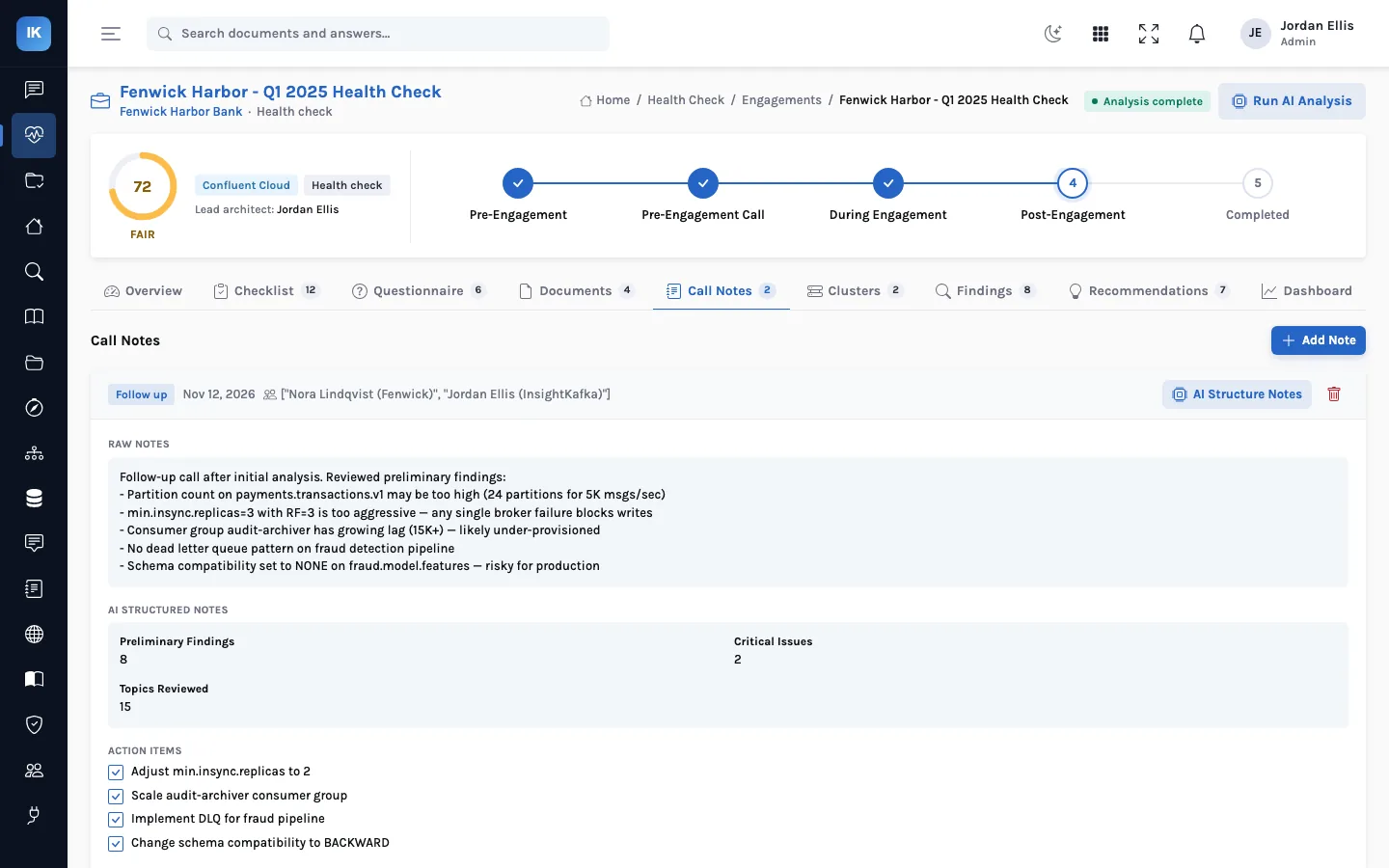
Call notes are typed as they are, during or after the call, with the call type (pre-engagement call, follow-up) and who attended. One click (AI Structure Notes) turns them into a summary, the key topics, action items, architecture, security and performance observations, and checklist answers where the notes give clear evidence. The raw notes are never replaced: a reviewer can always check the structured version against what was actually written down. (The sample engagements in the screens carry their own structured notes, grouped as key concerns and environment.)
| Said on the call | Becomes |
|---|---|
| “Consumer lag grows during peak trading hours” | A key concern; a pointer for the consumers category of the analysis |
| “Datadog alerting is noisy” | A monitoring concern; the source of a finding marked as coming from call notes |
| “We think we're over-provisioned on some topics” | A topics concern to check against partition counts |
The concern that became a finding
On the first call with the fictional Fenwick Harbor Bank, its platform architect says alerting produces too many false positives. The structured notes list it under key concerns. The architect records a medium-severity monitoring finding, sourced to the call notes, with a recommendation on how the alerts are set. The architect checks it against the alert definitions before it goes into the report.
From notes to checklist answers
Structuring a note also asks the model to map what was said to checklist items, answering Y, N or NA with the supporting detail, and only where the notes give clear evidence. Those answers are added to the checklist alongside the ones the configuration rules produced. The model is shown the first fifty checklist questions for this mapping, so a remark about a later area (platform management, say) stays in the structured notes rather than becoming a checklist answer.
| Note says | Possible checklist answer | What a reviewer should do |
|---|---|---|
| “All producers use acks=all” | Y on the producer durability item | Confirm in a producer configuration before relying on it |
| “We have no runbook for broker failure” | N on the operations item | Keep it; a missing runbook is a fact the team can state |
| “I think TLS is on everywhere” | None: not clear evidence | Ask for the listener configuration |
Limits worth knowing
- Long documents are cut. Parsing reads the first 50,000 characters of a document. Split a large questionnaire or audit into parts, or put the sections that matter first.
- Clusters are created once by name. If a parsed questionnaire names a cluster that already exists in the engagement, it is skipped rather than duplicated or updated; edit the cluster record directly if the answers changed.
- Parsing runs in the background. A document shows its status until parsing completes or fails, with the error kept on the document.
A checklist for good call notes
- Record who said it and their role in the attendees field.
- Write what was said, not what you concluded; the conclusion belongs in a finding.
- Note numbers exactly as given (“lag reached about 2 million at 9am”) and mark them as reported, not measured.
- Use the call type (kickoff, discovery, review, follow-up) so the timeline of the engagement is readable later.
Questions
What if the questionnaire and the configuration disagree?
Believe the configuration, and ask about the difference. A questionnaire records what the team thinks is set; a file records what is. The gap between the two is often a finding in itself, about documentation or change control.
Can we correct a structured note?
Edit the raw notes and run the structuring again, so the structured version and the checklist answers follow the correction. The raw text stays the source, so a correction belongs there first.
Can the customer fill in the questionnaire online?
Not in this release. The questionnaire is a file the customer fills in and you upload; parsing turns it into structured answers.
Are call notes included in the AI analysis?
Not directly. The analysis reads the cluster records and parsed documents. Call notes feed the checklist, through structuring, and the architect's own findings, which is where a finding sourced to the call notes comes from. If something said on a call should shape the analysis, record it in the cluster details or a document as well.